5AXIS3D Talk to us

Home · The prototype platform

Our platform

One working prototype, configured per project — not a catalogue model.

The machine below is our current prototype: a fully enclosed benchtop unit with a tilting build stage, touchscreen control and our own multi-axis controller and slicer. There is no fixed catalogue configuration — every unit is built to order, and travels, hotend, sensors and software options are agreed with the buyer before we build.

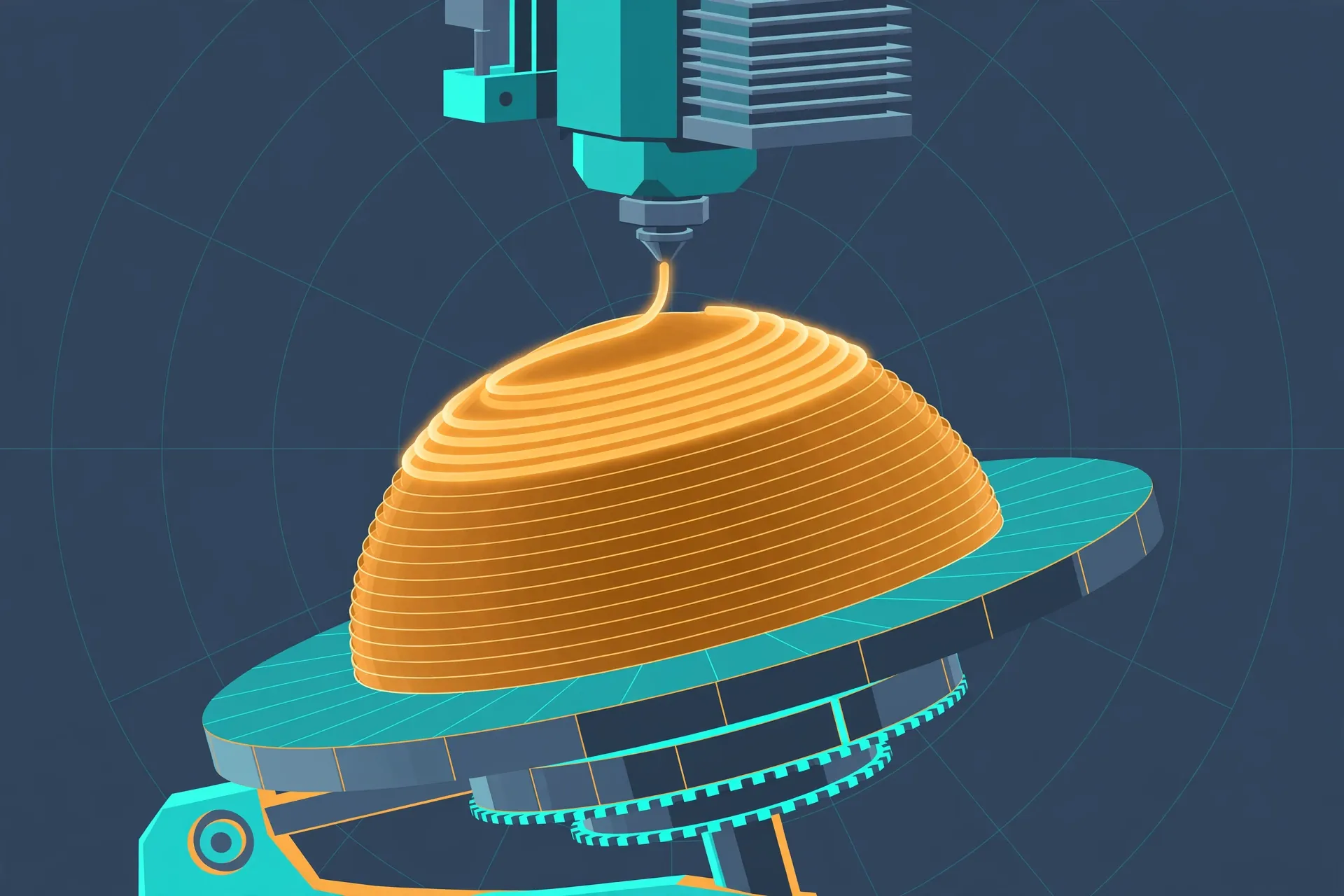
Illustration of a printer nozzle laying smooth curved layers over a dome-shaped part on a rotating build plate
Current prototype · Reference configuration

Benchtop 5-Axis Conformal FDM Printer

Built for labs and serious workshops: an enclosed machine that prints true non-planar toolpaths with simultaneous five-axis motion, driven by our POCENDER / PCD3D controller and curved-surface slicing software.

Process
FDM / FFF with conformal (non-planar) slicing
Motion
X / Y / Z linear + A / B / C rotary axes, simultaneous interpolation
Axis travel
X 220 × Y 190 × Z 180 mm (reference prototype)
Tool-centre control
RTCP — nozzle stays on path while axes re-orient
Controller
POCENDER / PCD3D multi-axis controller, touchscreen + web panel
Software
Curved-surface (conformal) slicer, developed in-house
Options
AI-assisted print simulation · self-inspection with compensation · remote operation
Format
Fully enclosed benchtop cabinet

Travel figures are the reference prototype's controller configuration; usable conformal volume depends on part geometry and tilt angles. Final specification of any unit is confirmed in writing before build — if your project needs different travels or sensors, that is a configuration conversation, not a problem.

Three ways to work with us

PATH 1

Get a prototype machine

One of the current-generation machines for your lab or workshop, configured for your materials and projects, with direct access to the people who built it as the platform evolves.

PATH 2

Commission a custom build

A machine specified around your research or application — different travels, sensing, hotend or software features. A custom five-axis unit has already been built and delivered to a university research lab this way.

PATH 3

Develop it with us

Joint development of multi-axis control, conformal slicing or a machine variant — the collaboration model we've worked under with research institutes and universities since 2022.

Control & software

The hard part isn't the frame. It's six axes moving as one, and a slicer that thinks in surfaces.

Five-axis printing fails or succeeds in the control stack. Ours pairs a multi-axis controller with RTCP — the tool centre point stays exactly on the programmed path while the machine re-orients around it — with our own curved-surface slicing software, developed alongside the hardware since 2022.

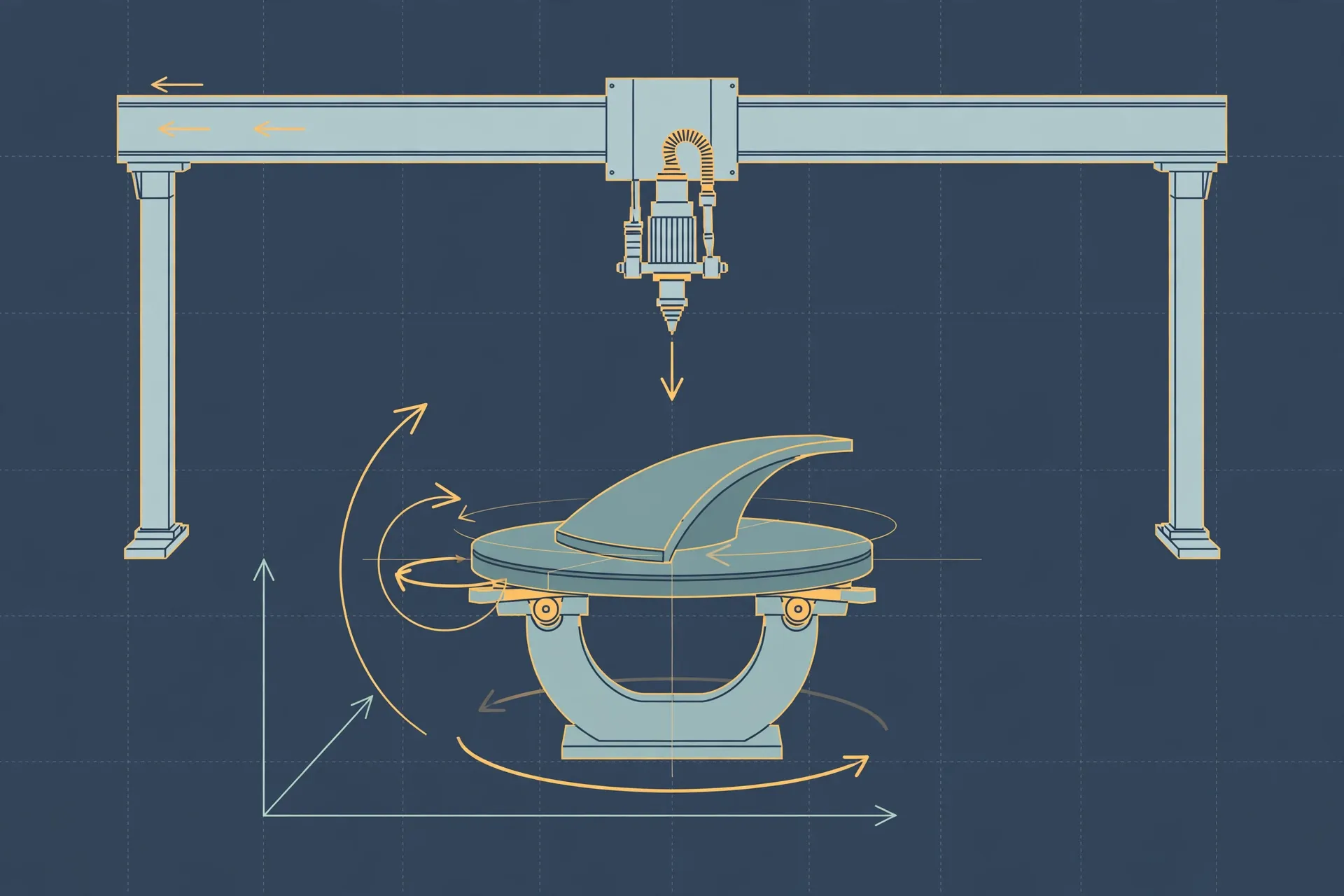
Blueprint-style illustration of five-axis kinematics: a gantry print head above a tilting, rotating trunnion table, with curved arrows showing the rotary axes

Real multi-axis control, with RTCP

Six axes — X, Y, Z plus the A, B and C rotary axes — interpolate simultaneously under the POCENDER / PCD3D controller, with RTCP (rotation tool centre point) keeping the nozzle tip exactly on the programmed path while the machine re-orients around it. Without RTCP, tilting the part drags the nozzle off its path; with it, conformal toolpaths stay true.

  • Simultaneous interpolation across linear and rotary axes
  • Touchscreen control on the machine
  • Per-axis travel, speed and acceleration parameters
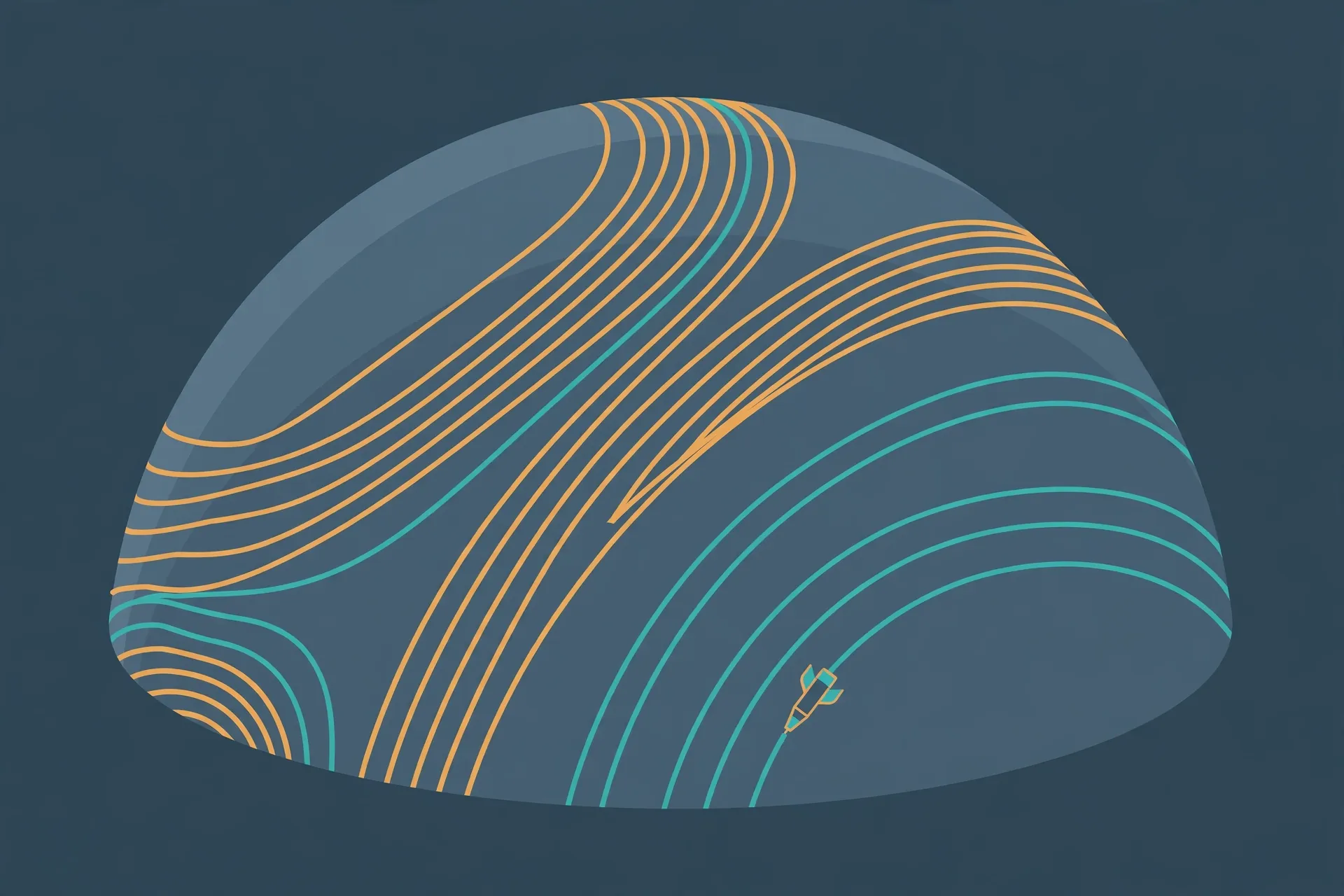
Abstract illustration of curved toolpath lines in amber and teal flowing over a dome surface, with a small nozzle following one curve

A slicer that thinks in surfaces — and remote operation

Our slicing software generates toolpaths on the part's surfaces instead of in flat planes — the software half of conformal printing, and an active research topic in its own right. The machine itself runs from a touchscreen or remotely through the POCENDER web panel: jog every axis, manage files, update firmware and monitor status from a phone or laptop. On custom builds, the stack extends further:

  • AI-assisted simulation of the print before it runs
  • In-process self-inspection with automatic compensation
  • Full remote control for shared and teaching labs
Flat-layer 3-axis vs. conformal 5-axis printing
Question3-axis FDM printer5-axis conformal machine
OverhangsSupport structures below ~45°, removed afterwardsTilt the part and print support-free, including undercuts
Layer shapeFlat slices; stair-stepping on every curveLayers follow the surface; smooth, stronger shells
Layer strengthWeak across flat layer linesMaterial laid along the surface and the load path
Existing partsPrint only on a flat bed, from abovePrint onto curved substrates and existing objects
Typical fitPrismatic parts, simple bracketsCurved shells, ducts, wearables, conformal research
Who it's for

An exploration, open to the people equipped to explore it.

Conformal printing is not a settled technology — the slicing theory, the motion strategies and the applications are all still being worked out, in public, by a small worldwide community. This platform exists for the people doing that work.

R1

Research institutes & university labs

Groups working on non-planar slicing, multi-axis motion, materials behaviour on curved layers, or conformal applications — who need real five-axis hardware to run experiments on, not just simulations. Joint development and slicer collaboration are how we've worked with institutes and universities since 2022.

R2

Teaching labs

Five-axis machining is standard curriculum; five-axis printing is not — yet. A benchtop machine with an open control stack gives students genuine multi-axis, RTCP and non-planar toolpath concepts on hardware they can see, measure and modify.

R3

Advanced makers & small studios

Experienced builders who have hit the wall of flat-layer printing — support scars on every curve, weak shells, impossible undercuts — and want to experiment with the technology the community itself voted the next core direction of FDM.

R4

Application pioneers

Teams exploring where conformal printing wins first: printing onto existing objects, curved functional surfaces, wearables and prosthetics, aerodynamic and fluid shells. If your application needs a machine variant that doesn't exist yet, that's a custom-build conversation.

Where we honestly are

This is a prototype platform, not a production product. Machines are built one at a time, to order, and the design is still evolving — you will find rough edges, and current builds are not yet at production-level repeatability or polish. We don't publish a catalogue price, a fixed lead time or fleet-support promises, because at this stage those numbers wouldn't be honest.

What you get instead: direct access to the engineers, a machine configured for your questions, and a say in where the platform goes next. The labs and makers who join at this stage are the ones shaping what five-axis conformal printing becomes.

How it works

From first message to a machine on your bench.

STEP 1

Tell us the question

What do you want to print, study or build? A model, a material, a research question — whatever you have. Honest scoping starts here.

STEP 2

Talk it through

A call with the engineers: is five-axis conformal the right tool, what configuration fits, and — just as important — what the prototype can and can't do yet.

STEP 3

Build to order

Your machine or collaboration is specified in writing, built, and tested against your own test geometry before it ships.

STEP 4

Explore, with us in the loop

Remote setup support, direct line to the developers, and your findings feeding the next iteration of the platform.