5AXIS3D Talk to us

The home of 5-axis 3D printing — the knowledge, the landscape, and a machine to build on.

Five-axis printing is a young field with no centre — so this site is built to be one: plain-English guides to conformal, non-planar printing, a map of the technology routes and the people exploring them, a glossary, and an open research agenda. Underneath it sits our own work: a prototype-stage 5-axis FDM platform — machine, multi-axis controller and curved-surface slicer — developed since 2022 and built to order for research institutes, universities and advanced makers.

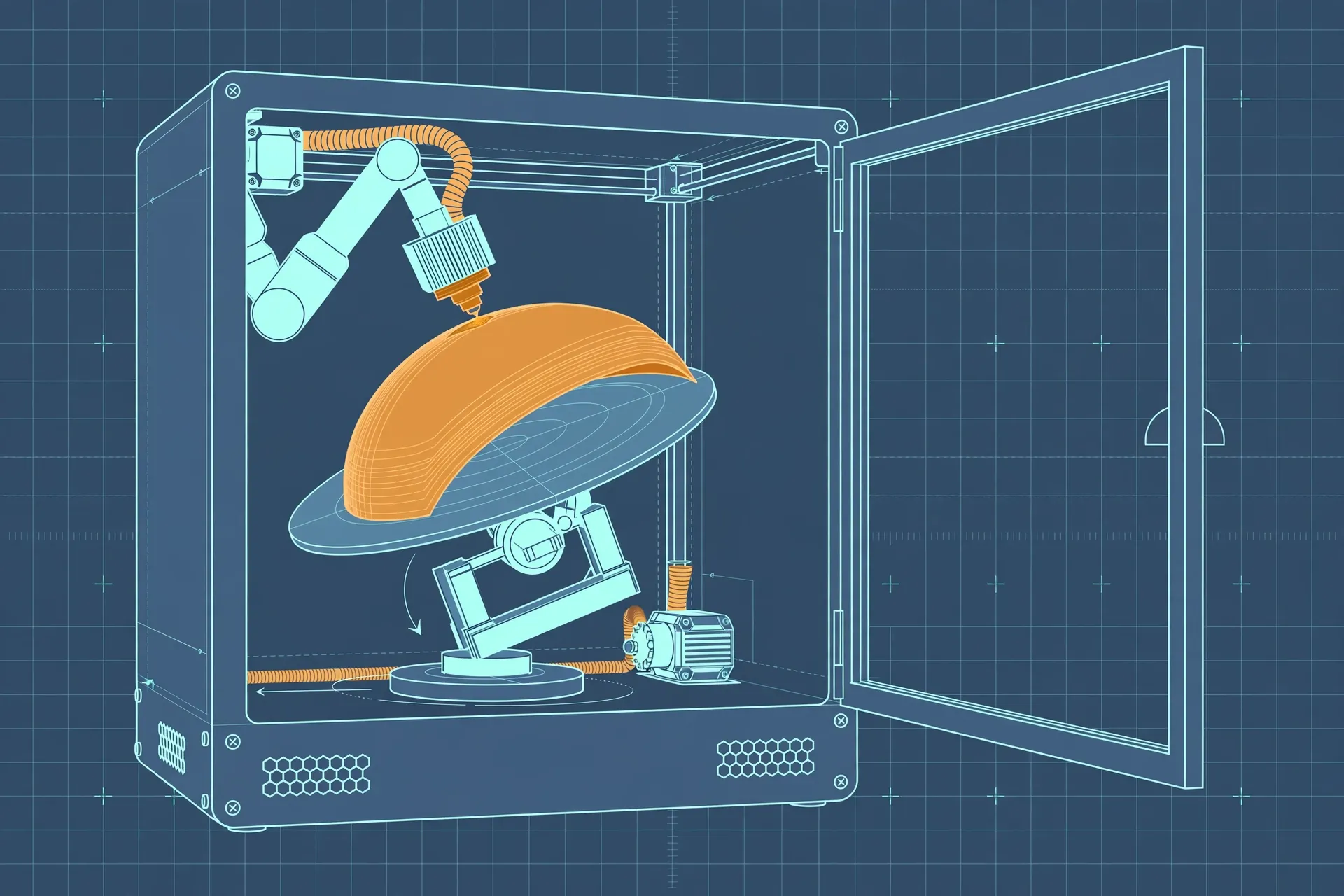
Blueprint-style illustration of a five-axis 3D printer whose tilting, rotating build stage prints a curved shell in amber layers, support-free
ILLUSTRATION — THE IDEA: TILT, ROTATE, AND PRINT THE CURVE ITSELF
Since 2022
Developing 5-axis conformal FDM — control, linkage and slicing
X·Y·Z + A·B·C
Six axes under one controller, simultaneous interpolation, RTCP
51.6%
Of voters in a Nov 2026 maker-community poll picked curved-surface (5-axis) printing as the next core FDM technology
Prototype stage
Built to order and co-developed with you — not yet a production appliance
The platform Simultaneous 5-axis interpolationRTCP tool-centre controlCurved-surface slicing softwarePOCENDER / PCD3D controllerRemote operationEnclosed benchtop format
GUIDE 01

What counts as "5-axis" printing?

A printer earns the label when the nozzle and the part can be re-oriented relative to each other while printing — three linear axes (X, Y, Z) plus two rotary axes working together. The rotary axes can live in three places: in the table (a tilting, rotating trunnion), in the head (a swivelling nozzle), or split between both. Each choice changes the machine's stiffness, collision behaviour and usable volume.
Read the full guide →

GUIDE 02

Non-planar slicing, explained

A conventional slicer intersects the model with horizontal planes and emits flat perimeters. A non-planar slicer instead generates toolpaths on the part's surfaces: offsetting paths across the geometry, assigning each point a nozzle orientation (usually the surface normal), then checking the whole motion for collisions between nozzle, part and machine.

Read the full guide →

GUIDE 03

Reading the landscape: six routes to multi-axis

"Multi-axis printing" covers machines with very different ambitions. Trunnion-table FDM (our route) targets true conformal layers at bench scale. Tilting-head designs keep a big flat bed but fight head collisions. 3+2 indexing is the pragmatic middle. Belt printers add one endless axis for long parts at a fixed angle — useful, but not conformal. Robotic arms trade accuracy for metre-scale freedom. Print-and-mill hybrids buy surface finish with a machining pass, at hybrid prices.

Read the full guide →

GUIDE 04

Starting 5-axis research: a practical checklist

For labs setting up a non-planar programme, the questions that save the most time are asked before any hardware arrives:

Read the full guide →

Definitions

Three terms, defined once and used consistently.

The whole site uses these words with exactly these meanings — here and in the full glossary.

5-axis 3D printing
Additive manufacturing where the nozzle and part re-orient relative to each other during printing — three linear axes plus two rotary axes — so material can be deposited along directions other than straight up. Full glossary entry →
Conformal printing
Layers that follow (conform to) a curved surface — the surface of the growing part, or an existing object. In printed electronics the word centres on printing onto existing surfaces; in FDM it usually means curved layers. This site uses it for both, and says which. Full glossary entry →
Non-planar printing
Toolpaths not confined to flat horizontal planes, producing curved layers. Used almost interchangeably with "conformal" in the FDM community; the stricter term of the two. Full glossary entry →
Why conformal

Flat layers are the compromise. Curved layers are the point.

A 3-axis printer can only stack horizontal slices, so every curved surface becomes a staircase and every overhang needs scaffolding. Add rotary axes and keep the nozzle normal to the surface, and the geometry rules change completely.

01

Overhangs & undercuts, support-free

By tilting the part as it grows, walls and undercuts that would need support structures on a flat-layer machine print self-supported. No supports to design, print, break off and sand away — and internal, curved geometries that flat slicing simply cannot reach become printable.

02

Strength along the surface

FDM parts are weakest across layer lines. Conformal layers run along the part's surface — along the load path — instead of slicing across it, so curved shells, ducts and brackets behave more like the continuous material they imitate.

03

Smooth curves, no stair-stepping

Layers that follow the surface eliminate the staircase finish on domes, tubes and freeform shells — the surfaces come off the machine smooth, with far less post-processing, which matters for airflow, fluid flow and anything that touches skin.

04

Print onto existing parts

Five axes let you deposit onto curved, already-existing objects: add features to a printed or machined substrate, repair a worn curved surface, or print directly onto a shell. The substrate becomes part of the build — a research direction flat-layer machines can't explore at all.

Our platform

One working prototype, configured per project — not a catalogue model.

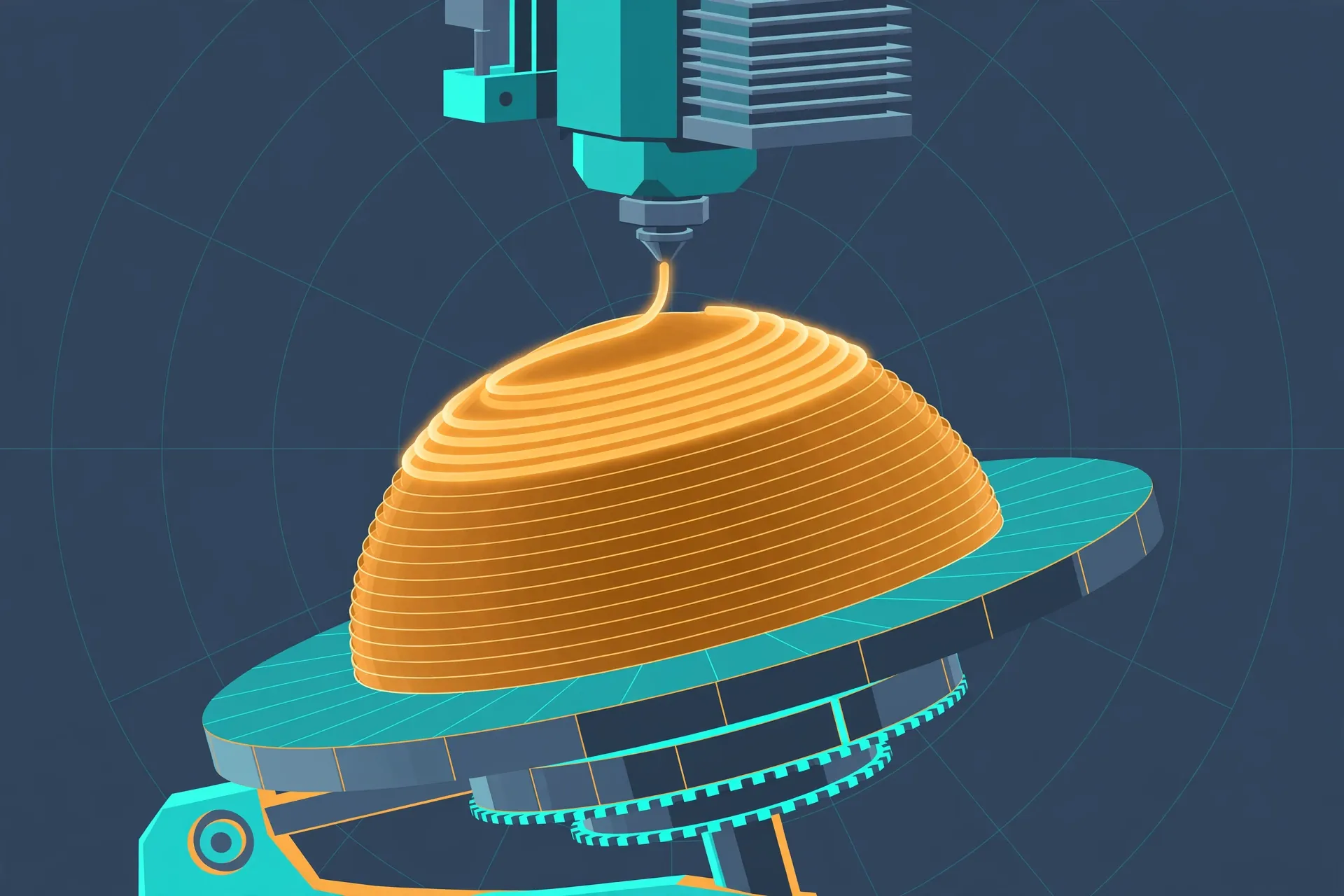
The machine below is our current prototype: a fully enclosed benchtop unit with a tilting build stage, touchscreen control and our own multi-axis controller and slicer. There is no fixed catalogue configuration — every unit is built to order, and travels, hotend, sensors and software options are agreed with the buyer before we build.

Illustration of a printer nozzle laying smooth curved layers over a dome-shaped part on a rotating build plate
Current prototype · Reference configuration

Benchtop 5-Axis Conformal FDM Printer

Built for labs and serious workshops: an enclosed machine that prints true non-planar toolpaths with simultaneous five-axis motion, driven by our POCENDER / PCD3D controller and curved-surface slicing software.

Process
FDM / FFF with conformal (non-planar) slicing
Motion
X / Y / Z linear + A / B / C rotary axes, simultaneous interpolation
Axis travel
X 220 × Y 190 × Z 180 mm (reference prototype)
Tool-centre control
RTCP — nozzle stays on path while axes re-orient
Controller
POCENDER / PCD3D multi-axis controller, touchscreen + web panel
Software
Curved-surface (conformal) slicer, developed in-house
Options
AI-assisted print simulation · self-inspection with compensation · remote operation
Format
Fully enclosed benchtop cabinet

Travel figures are the reference prototype's controller configuration; usable conformal volume depends on part geometry and tilt angles. Final specification of any unit is confirmed in writing before build — if your project needs different travels or sensors, that is a configuration conversation, not a problem.

See the full platform — controller, slicer and cooperation models

FAQ

Straight answers, including the uncomfortable ones.

What is conformal (non-planar) 5-axis 3D printing?

A conventional FDM printer stacks flat layers and can only move in X, Y and Z. A 5-axis machine adds rotary axes, so the nozzle stays normal to the surface being printed and the layers themselves curve to follow the part — that is conformal, or non-planar, printing. Overhangs and undercuts print without support structures, curved shells come out smooth instead of stair-stepped, and material is laid along the surface, where the loads run, instead of across flat slices.

Is this a production-ready machine I can buy off the shelf?

Not yet — and we would rather say so plainly. The platform is at prototype stage: every machine is built to order, configured with the buyer, and still evolving. It is not a mass-produced, lights-out production printer, and it rewards users who are technically engaged. If you need certified fleet repeatability today, this is not the right purchase yet. If you want to research, teach or push non-planar printing — and shape the machine while you do — this is exactly the stage to join.

Who is the machine for?

Research institutes and university labs working on non-planar printing, multi-axis motion or slicing algorithms; teaching labs that want students on real five-axis hardware; and advanced makers and small studios who have hit the limits of flat-layer printing. Typical projects include conformal printing research, curved composite shells, printing onto existing curved parts, and custom machine or slicer development with us.

How large a part can it print?

The current reference prototype is configured with axis travel of X 220 × Y 190 × Z 180 mm. The usable conformal volume is smaller than the travel box and depends on part geometry and tilt angles — send us your model and we will check it honestly. Custom builds can be specified with different travels.

All 12 questions, answered in full →

Start a conversation

Working on something flat layers can't do? Tell us about it.

A prototype machine, a custom build, a slicer collaboration, a research idea — or a correction to this hub: all of them start the same way.

Prefer email directly? cqq365@gmail.com

Development & workshop: Suzhou, China · Working language: English

Go to the contact form